
 Business License
304/316/316L Stainless Steel Wire Mesh Filters & Strainers: A Complete Selection Guide for Engineers
Specifying a stainless steel wire mesh filter or strainer is not a “one-grade-fits-all” decision. A 304 mesh that performs flawlessly in a water treatment pre-filter may fail within months in an offshore glycol filtration skid. A 316L strainer element that lasts five years in a chemical plant may be over-specified — and unnecessarily expensive — for a simple food-grade sieve.
This guide walks through the real engineering differences between 304, 316, and 316L stainless steel wire mesh filters and strainers, how micron ratings actually work, and how to match the right specification to your process conditions.
304 vs. 316 vs. 316L: What Actually Changes in a Filter Element
All three grades are austenitic stainless steels with the same fundamental crystal structure. The differences come down to alloying elements — and those differences determine where each grade will survive and where it will fail.
| Property | 304 | 316 | 316L |
|---|---|---|---|
| Chromium (%) | 18–20 | 16–18 | 16–18 |
| Nickel (%) | 8–10.5 | 10–14 | 12–15 |
| Molybdenum (%) | — | 2–3 | 2–3 |
| Max Carbon (%) | 0.06 | 0.08 | 0.03 |
| PREN (Pitting Resistance) | ~18 | 24–26 | 24–26 |
| Relative Cost | 1.0× (baseline) | ~1.3× | ~1.4–1.5× |
304 is the workhorse. It handles fresh water, neutral chemicals, oils, and air filtration without issue. Its PREN of approximately 18 means it has no meaningful resistance to chloride pitting — seawater, brine, or chlorinated cleaning agents will attack it.
316 adds molybdenum, which is the single most effective alloying element for resisting pitting and crevice corrosion in chloride-bearing environments. This raises the PREN to 24–26, making 316 suitable for coastal installations, chemical processing, and marine filtration.
316L is chemically identical to 316 but with carbon content capped at 0.03%. This low carbon content prevents chromium carbide precipitation during welding — a phenomenon called sensitisation that creates corrosion pathways along grain boundaries. If your filter element will be welded, pleated and welded, or assembled into a cartridge with any thermal joining process, 316L is the specification you need, not standard 316.
Key insight: For non-welded mesh used in chloride service, standard 316 offers identical corrosion performance to 316L at a lower material cost. The 316L premium is justified specifically when welding is involved.
Micron Rating: The Specification Most Buyers Get Wrong
A mesh filter’s actual particle retention is defined by its micron rating, not its mesh count. And micron ratings come in two very different forms.
Absolute rating means 98–99% of particles larger than the stated micron are retained. This is the specification you need when failure to capture a specific particle size has safety, regulatory, or product-quality consequences — pharmaceutical final filtration, food and beverage, hydraulic fluid, and semiconductor chemicals.
Nominal rating means roughly 50–80% retention at the stated micron. A 100 µm nominal mesh can pass significant quantities of 80–120 µm particles. Nominal ratings are acceptable for pre-filters, strainers, and coarse protection, but they are not suitable for critical filtration.
This distinction matters because many woven meshes above 100 µm are marketed with nominal ratings only. If your process requires 100 µm absolute, you typically need a mesh rated nominal at 60–80 µm — a finer specification than the mesh count alone would suggest.
For reference, common wire mesh filtration ratings range from approximately 5 µm to 1000 µm depending on weave and construction-21. Dutch weave meshes can reach down to 5 µm absolute in single-layer construction, while sintered multilayer laminates achieve 1–2 µm.
How Weave Pattern Affects Filter and Strainer Performance
Grade selection is only half the equation. Weave pattern determines pore geometry, mechanical strength, and cleanability.
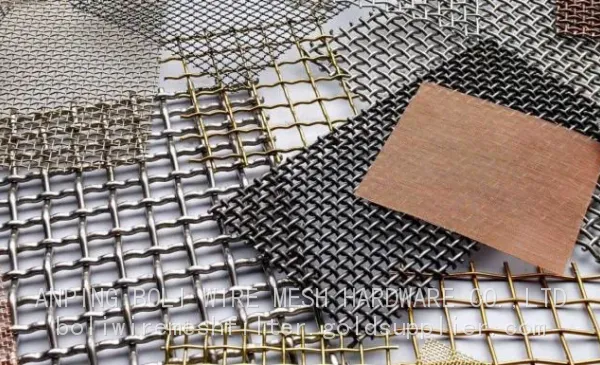
Plain weave (1 over, 1 under) produces square, uniform openings with 30–50% open area. It is the standard choice for general-purpose strainers, liquid–solid separation, and screening where predictable flow and easy cleaning matter more than ultimate strength. Plain weave is available from approximately 2 µm to several millimetres-1.
Twill weave (2 over, 2 under) locks wires more tightly, handling heavier loads and greater mechanical stress. It reaches finer openings without the pressure-drop penalty of Dutch weave — typically down to around 20 µm nominal. Twill weave is preferred for pleated filter elements and high-pressure strainer baskets-1.
Dutch weave packs fine weft wires tightly against heavier warp wires, creating a tortuous filtration path that achieves the finest absolute ratings in single-layer woven mesh. Plain Dutch weave ranges from 12×64 mesh to 80×700 mesh; twill Dutch weave extends from 20×250 mesh to 400×2800 mesh. The trade-off is higher pressure drop, harder cleaning, and greater susceptibility to blinding-1.
Reverse Dutch weave — many heavy warp wires with fewer fine weft wires — is the strongest Dutch variant and the standard choice for hydraulic filter elements, fuel filtration, and high-pressure polymer melt filtration where the mesh must survive significant differential pressure without deformation-1.
Matching Filters and Strainers to Industry Applications
The right specification depends entirely on the operating environment. Here is how the three grades map to real industrial sectors.
Chemical & Petrochemical Processing
Catalyst recovery screens, acid-wash mesh, and polymer melt filtration demand resistance to aggressive chemicals and elevated temperatures. 316 or 316L is the default specification. Molybdenum content provides the pitting resistance needed for chloride-bearing process streams.
Food, Beverage & Pharmaceutical
Hygienic filtration — juice clarification, dairy processing, solvent recovery, CIP/SIP-compatible assemblies — requires cleanability and corrosion resistance that will not leach contaminants. 316L is preferred for welded filter assemblies and any element subject to sterilisation cycles. For non-welded sieving and grading screens, 304 is often sufficient.
Water Treatment & Desalination
Reverse osmosis pre-filtration, wastewater screening, and desalination intake screens operate in chloride-rich conditions. 316 or 316L is required for long-term performance. In seawater service, 304 fails within months while 316L lasts several years under comparable conditions-.
Oil & Gas
Sand control screens, glycol filtration, produced water polishing, and hydraulic system filtration demand high-pressure tolerance and corrosion resistance. 316L Dutch weave or reverse Dutch weave elements are standard for hydraulic and fuel filtration, surviving differential pressures that would deform plain weave cloth-21.
Mining & Minerals
Slurry guards, dewatering screens, and acid leach circuits combine abrasion with chemical exposure. 316 offers the necessary balance of corrosion resistance and mechanical durability. Twill weave provides better resistance to wire deformation under heavy solids loading.
A Practical Selection Framework for Engineers
Step 1 — Define your micron requirement. Determine whether you need absolute or nominal filtration. If particle carryover has safety or regulatory consequences, specify absolute and verify the mesh rating accordingly.
Step 2 — Assess chloride exposure. Below 200 ppm chloride with pH above 5, 304 is typically sufficient. Above that threshold, or in the presence of organic acids, specify 316 or 316L.
Step 3 — Determine whether welding is involved. If the mesh will be welded into baskets, pleated cartridges, or support frames, 316L prevents intergranular corrosion that 316 cannot resist after thermal exposure.
Step 4 — Match weave to pressure and filtration demand. General screening: plain weave. Fine filtration with mechanical strength: twill weave. Maximum filtration precision with pressure tolerance: Dutch or reverse Dutch weave.
Step 5 — Calculate lifecycle cost, not unit price. The material cost differential between 304 and 316L is typically 25–50%. But a premature strainer failure in a continuous process plant can cost thousands of dollars per day in downtime — far exceeding any material savings.
Common Specification Mistakes
Ordering by mesh count alone. Mesh count does not define micron rating. Two 100-mesh cloths with different wire diameters have different apertures and different filtration performance.
Using 304 in coastal or chemical service. 304’s PREN of approximately 18 offers no meaningful chloride resistance. The cost saving is rarely worth the failure risk.
Specifying 316 instead of 316L for welded elements. Standard 316 sensitises during welding, creating grain-boundary corrosion pathways. 316L eliminates this failure mode.
Ignoring open area and pressure drop. A finer mesh increases pressure drop. If your strainer housing is sized for a coarse mesh, installing a finer Dutch weave element may require a larger housing or higher pump pressure.
Custom Filter and Strainer Solutions from BOLI
At BOLI Wire Mesh Hardware Co., Ltd. (www.boliwiremesh.com), we manufacture stainless steel wire mesh filters and strainers in 304, 316, and 316L, tailored to your process conditions. Our product range includes:
Wire mesh filter discs and tubes in plain, twill, and Dutch weave
Five-layer sintered mesh elements for high-pressure and high-temperature filtration
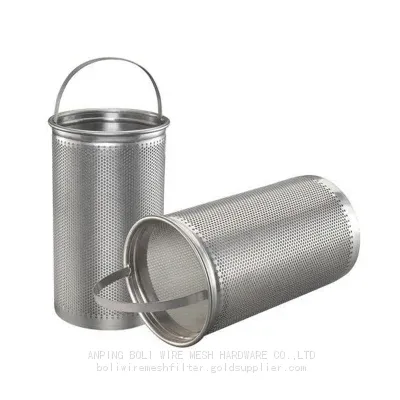
Strainer baskets and cylinders for liquid and gas filtration
Pleated filter cartridges in 304/316L woven mesh or sintered fiber felt
Custom micron ratings from 1 µm to 300 µm, with full material certification
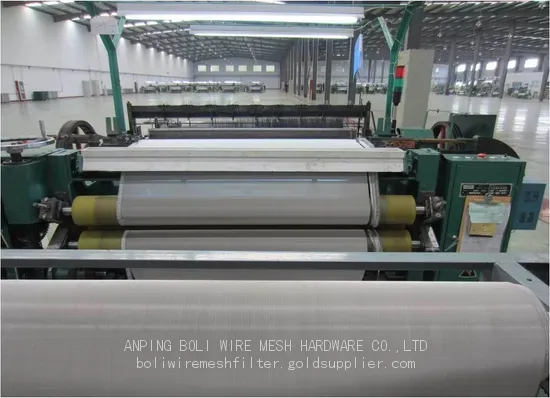
Our design process begins with material selection, moves through precision wire drawing and weaving, and ends with rigorous mechanical and corrosion testing — ensuring every filter element meets the demands of its operating environment-40.
Send us your medium, temperature, chloride exposure, micron requirement, and flow rate. Our engineering team will recommend the optimal grade, weave, and element configuration for your application — and provide a quotation with material certificates.
Request a Quote →
FAQ
What is the difference between a filter and a strainer?
A strainer typically removes larger particles (often above 100–200 µm) as a protective device upstream of pumps, valves, or instrumentation. A filter removes finer particles and is often the final barrier before a process or product. Wire mesh serves both functions, but the specification — weave, micron rating, and grade — differs.
Can I use 304 stainless steel wire mesh for water filtration?
Yes, for fresh water and neutral pH applications. For chlorinated water, seawater, or any chloride-bearing stream, 316 or 316L is required to prevent pitting corrosion.
What is the finest micron rating available in stainless steel wire mesh?
Single-layer Dutch weave achieves approximately 5 µm absolute. Sintered multilayer laminates reach 1–2 µm. For sub-micron filtration, alternative media such as sintered metal fiber or ceramic membranes are required.
Do you provide material certificates with filter mesh orders?
Yes. BOLI provides EN 10204 3.1 material certificates and full traceability documentation for all stainless steel wire mesh filter and strainer products.
Recently Posted
-
Sintered vs. Woven Stainless Steel Wire Mesh Filters: Which One Fits Your Process?
October 10, 2026Two filters can share the same 316L grade, the same 25 µm rating, and the same outer dimensions — yet behave completely differentl Read More
 -
How Stainless Steel Wire Mesh Filters Are Manufactured: From Wire Drawing to Industrial Application
October 10, 2026A stainless steel wire mesh filter is not simply “woven cloth cut to size.” The gap between a commodity mesh disc and a precision- Read More
 -
Stainless Steel Wire Mesh Weave Types: Plain, Twill & Dutch Weave Explained
October 10, 2026Stainless Steel Wire Mesh Weave Types: Plain, Twill & Dutch Weave ExplainedChoosing the right stainless steel wire mesh cloth Read More
 -
304 vs 316 vs 316L Stainless Steel Wire Mesh Cloth: Which Grade Should You Specify for Your Application?
October 10, 2026304 vs 316 vs 316L Stainless Steel Wire Mesh Cloth: Which Grade Should You Specify for Your Application?Choosing the wrong stainle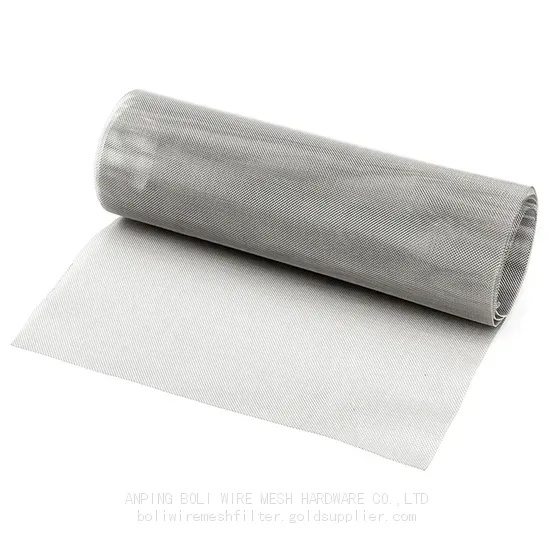 Read More

Contact Us

Recommended Products
-
 Stainless Steel Perforated Strainer .oil Mesh Filter Air Filter Mesh StrainerUS$ 1 - 20MOQ: 10 Bags
 -
AISI 304 316 316L Plain Weave Woven Stainless Steel Wire Netting For Oil Filter Air Filter MakingUS$ 1.0 - 10.0MOQ: 10 Square Feet
-
Factory Manufacturer Woven Stainless Steel Wire Mesh Screen on Sale Wholesale SUS 304 316 Stainless Steel Wire Mesh High Strength AISI304 Stainless Steel Filter Screen Reverse Dutch Wire Mesh 4 8 20 100 120 200 250 Mesh Stainless Steel Woven Filter MeshUS$ 1.0 - 10.0MOQ: 10 Square Feet
-
Qualified Plain Weave Woven Stainless Steel Wire Mesh Screen on Sale Wholesale SUS 304 316 Stainless Steel Wire Mesh High Strength AISI304 Stainless Steel Filter Screen Reverse Dutch Wire Mesh 4 8 20 100 120 200 250 Mesh Stainless Steel Woven Filter MeshUS$ 1.0 - 10.0MOQ: 10 Square Feet
-
100% Food Grade Nylon Mesh White Color Nylon Mesh Cloth Food Grade 8um 10um 200um 60um 100um 600um Nylon MeshUS$ 1 - 20MOQ: 10 Square Meters
-
Nylon Filter Cloth Food Grade 8um 10um 200um 60um 100um 600um Nylon MeshUS$ 1 - 20MOQ: 10 Square Meters
-
SS304 316 Stainless Steel Perforated Filter Cartridge With Flange and Handle Accept OEM.factory SupplierUS$ 1 - 20MOQ: 10 Bags
-
Stainless Steel Wire Mesh Filter Cartridges Filter Cylinder Bucket Strainer Mesh for Beer FiltrationUS$ 1 - 20MOQ: 10 Bags
-
Wholesale SUS 304 316 Stainless Steel Wire Mesh High Strength AISI304 Stainless Steel Filter Screen Reverse Dutch Wire Mesh Stainless Steel Wire Cloth Mesh 4 8 20 100 120 200 250 300 325 635 2000 3500 Mesh Stainless Steel Woven Filter MeshUS$ 1.0 - 10.0MOQ: 10 Square Feet
-
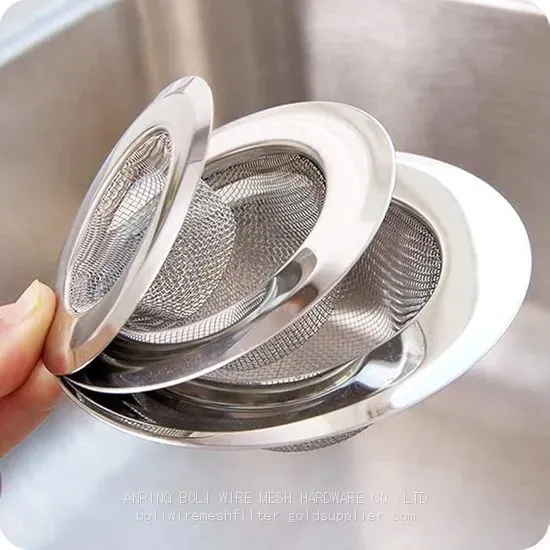
BOLI QUALITY Kitchen Accessories Sink Waste Filter Net Strainer Mesh Drain Strainer Drain Filter Strainer Basket Strainer BL021US$ 1 - 20MOQ: 10 Bags
-
Mesh Perforated Mesh Filter Bucket Strainer Basket/ Sintered Stainless Steel Wire Mesh Cone Filter/Perforated Wire Mesh Filter Bucket StrainerUS$ 1 - 20MOQ: 10 Bags
-
Nylon Filter Cloth 80-500 Mesh White Screen Filtration Food Grade Water Industrial ClothUS$ 1 - 20MOQ: 10 Square Meters
-
FDA Food Grade Nylon Filter Mesh/ 100 220 500 Micron Food Grade Nylon Filter Mesh ClothUS$ 1 - 20MOQ: 10 Square Meters
-
Polyester Steel Breaker Fabric Tear-Resistant Dipped Steel Cord Fabric Nylon Brass Coated Steel Cord for Making Tyre 2*0.30mm Belt/Tear-Resistant Dipped Steel Cord Fabric for Conveyor Belt Tear-Resistant Dipped Steel Cord Fabric for Conveyor BeltUS$ 1 - 200MOQ: 10 Kilometers
-
Tear-Resistant Dipped Steel Cord Fabric Nylon Brass Coated Steel Cord for Making Tyre 2*0.30mm Belt/Tear-Resistant Dipped Steel Cord Fabric for Conveyor Belt Tear-Resistant Dipped Steel Cord Fabric for Conveyor BeltUS$ 1 - 200MOQ: 10 Kilometers
-
BOLI Steel Cord Fabric for Conveyor Belt IW/TW/SW Belt Woven Steel Cable/STEEL Cord Fabric for Rubber Conveyor BeltsUS$ 1 - 200MOQ: 10 Kilometers
-
Top Quality Industrial Walkways Heavy Steel Bar Grating.Hot Dip Galvanized Bar Steel Grating .Top QualityUS$ 1 - 200MOQ: 10 Square Meters
-
BOLI -Stainles Steel Floor Steel Grating China GOLD Suppliers Dustproof Feature Upper and Lower Clip Steel Grating Used for Showcase GroundUS$ 1 - 200MOQ: 10 Square Meters
-
BBQ MESH Crimped Wire Mesh for Mining Crusher Screen Wholesale High Quality Stainless Steel Crimped Mesh Screen 304 316 316LUS$ 1 - 20MOQ: 10 Square Meters
-
Carbon Steel Strong Quality Crimped Wire Mesh for Mining Crusher Screen Wholesale High Quality Stainless Steel Crimped Mesh Screen 304 316 316LUS$ 1 - 20MOQ: 10 Square Meters